Post by Emily Nicholson
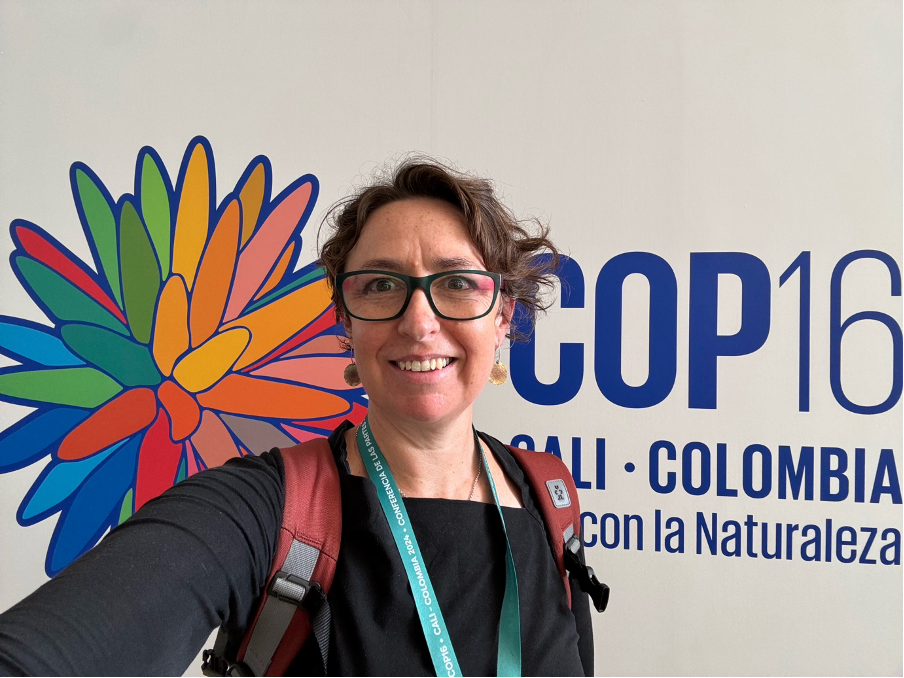
The 16th Conference of the Parties (COP16) of the UN Convention on Biological Diversity (CBD) was held in October 2024 in Cali, Colombia. I was a member of IUCN’s delegation, focusing on the monitoring framework. Over the last 18 months, I’ve worked with experts from around the world as a member of the Ad Hoc Technical Expert Group (AHTEG) on indicators, established by the CBD to provide guidance to parties on its monitoring framework. COP16 provided an opportunity to meet with many of the AHTEG members, and discuss our recommendations directly with parties. Here are some of my highlights.

One of the highlights of COP16 was the historic decision to establish a subsidiary body on Article 8(j) and related provisions of the Convention on matters related to Indigenous Peoples and Local Communities (IPLCs). This was the work of several decades by representative bodies of IPLCs, and was celebrated across the board. The strong presence of Indigenous peoples across the COP, generously sharing traditional knowledge, customs and dress, and the welcome of local Indigenous peoples were highlights of the COP broadly.
Another highlight was the establishment of the Cali Fund to contribute to the biodiversity finance gap and reward the stewards of biodiversity. The Cali fund will be a multilateral benefit-sharing mechanism from use of Digital Sequencing Information (DSI). Details are to be resolved in the period until COP17, but contributions will be voluntary from the private sector, and aimed at large multi-nationals. Funds will be distributed both to national governments and directly to Indigenous peoples and Local Communities.
Unfortunately decisions related to resource mobilisation were not resolved, again after extensive negotiations, and the Conference was suspended 12 hours after its intended closure (at 8.30 am on Saturday 2nd Nov) due to loss of quorum. Other decisions that were not resolved included the Mechanisms for planning, monitoring, reporting and review, including the monitoring framework. Ultimately, although most of the text on the monitoring framework was agreed in contact groups and working groups (see cop-16-l-26-en), the decision was not taken. It is hoped this will be passed when COP16 in reconvened in early 2025.
Two key aspects of the monitoring framework that were agreed by parties are important in terms of our work.
- A new headline indicator, 22.1 Land-use change and land tenure in the traditional territories of indigenous peoples and local communities, which was proposed after ongoing work by a working group on Traditional Knowledge Indicators. There are also many recommended disaggregations of other headline indicators that relate to traditional Indigenous territories.
- The IUCN Global Ecosystem Typology was recommended by AHTEG for reporting and disaggregation of ecosystem-related indicators. After lengthy discussion, the final text invites parties to “make use of the Global Ecosystem Typology, or an equivalent methodology, and cross-reference their national ecosystem data with levels 2 and 3 of that typology”; the typology is similarly listed in the recommended disaggregations for several headline indicators, including A.1 Red List of Ecosystems, A.2 Extent of Natural Ecosystems and 2.1 Area under restoration. This will support consistent reporting on ecosystem across indicators and across countries, allowing us to more effectively measure progress in conservation action and outcomes for ecosystems.
In addition to the official events and negotiations, there were hundreds of events at the COP. These include Pavilions hosted by various organisations, including IUCN , a Nature Positive coalition, countries, Indigenous groups and funders.
Bio: Emily Nicholson is a Professor in Conservation Biology in the School of Agriculture, Food and ecosystem Sciences at The University of Melbourne. She co-leads the IUCN Red list of Ecosystems Thematic group in IUCN’s Commission on Ecosystem Management, and was a member of the Ad Hoc Technical expert Group (AHTEG) on indicators, established by the Convention on Biological Diversity to provide guidance to parties on the GBF monitoring framework.
 Conservation Science