
Much of our work includes working across sectors to support better decisions for biodiversity and people. This includes working with Indigenous peoples, the private sector, NGOs and intergovernmental organizations.
About our research:
We collaborate with a range of management and conservation organisations for better outcomes for social-ecological systems.
- Ecosystem approaches to private sector contributions to nature: We are working with IUCN and the Nature Positive Initiative to improve the use of ecosystem data and knowledge in market-led approaches such as TNFD, and sustainability standards such as GRI and ISSB. The aim of this work is to better integrate science-based standards for ecosystem assessment, such as the IUCN Red List of Ecosystems and UN SEEA Ecosystem accounting, into private sector disclosure, risk assessment and action for better conservation outcomes.
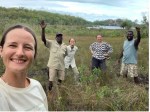
- Partnerships with Indigenous peoples and traditional knowledge: The roles of Indigenous peoples and local communities are critical to sustaining biodiversity, culture and social ecological systems. Current projects include planning for sustainable development and biodiversity on the Tiwi Islands, in collaboration with the Tiwi Land Council to support the Land Council in planning and management decisions, and mapping and monitoring biodiversity. This work is undertaken in collaboration with Brett Murphy and Jane Elith (University of Melbourne), and others. Publications from this project include:
- Young, A. R., Davies, H. F., Ayre, M. L., Brekelmans, A., Bryan, B. A., Elith, J., Hadden, K., Kerinaiua, M., Keith, D. A., Lewis, D. L., Munkara-Murray, K. M., Ryan, S., Spencer, M., & Nicholson, E. (2025). Applying the IUCN Global Ecosystem Typology to classify, describe, and map ecosystems based on regional data and Indigenous knowledge. Conservation Biology, e70099. https://doi.org/10.1111/cobi.70099
- Kerinaiua, Mavis, Brekelmans, Alana, Spencer, Michaela, Ayre, Margaret, Jones, Mitch, Young, Alys Rhiannon, Kerinaiua , Fiona, Kurrupuwu , Ancilla, Kantilla , Callista, Alimankinni , Jacinta, Orsto , Francis, Puruntatameri , Francilla, Puantulura , James Darren and Nicholson, Emily. (2025) Composing, decomposing, and recomposing engagement in Indigenous-led research for land and sea management, Tiwi Islands, Australia. AlterNative: An International Journal of Indigenous Peoples 21, 274-284. DOI: 10.1177/11771801251334917
- Ecosystem services: Previous research with colleagues at Deakin University and The Nature Conservancy aimed to quantify the multiple benefits people and communities derive from saltmarsh, mangrove and seagrass coastal ecosystems. These benefits, encompassed in the term ‘ecosystem services’, or simply, ‘nature’s benefits’ include carbon storage and sequestration (blue-carbon), coastal protection from waves and storm surges, habitat provision for recreationally and commercially important fish species, and tourism and recreational revenue. Critical to the success of the project is the communication of these benefits in a simple way that can be understood and applied by coastal stakeholders and decision makers (including community groups, engineers, politicians, policymakers and the financial sector) thereby strengthening the case for large-scale marine ecosystem protection and rehabilitation. This also forms part of our work on ecosystem accounting, in collaboration with the UN Statistics Division, on UN SEEA Ecosystem Accounting standards and their application.
- Conservation planning: Systematic conservation planning, also known as spatial conservation prioritization, is a key aspect of our research. Our work in this area includes planning for species persistence, integrating social and biodiversity values, types of biodiversity data, and effects of uncertainty on decisions.
- Quantitative modelling: To ensure the supply of ecosystem services and biodiversity, we need an improved understanding of the interactions between humans and the natural environment they depend upon, and decision tools that include human behaviour. Quantitative models can help with both understanding and supporting decisions in the management of social-ecological systems. We will integrate models of economic development, biodiversity and ecosystem services for case study ecosystems, to understand and predict the benefits and impacts of development options. We will then integrate the models into new tools for quantifying the effects of different development scenarios, including agricultural development, and for land-use planning that accounts for real-world complexity and local land management goals.
- Making conservation decisions under uncertainty: Conservation decisions are inevitably made with incomplete and uncertain data, and based on uncertain models. Better tools and frameworks are therefore needed to understand types and sources of uncertainty, manage it and subsequently improve the robustness of management decisions. This research theme spans across all the others listed – uncertainty is pervasive!
 Conservation Science